The Story of Piombini Mobili: Wood, Design, and Artisan Passion for 100 Years

CHAPTER 1

Grazie a Mario Piombini...

Mario Piombini and the first furniture company.

Mario Piombini was born in 1897 in Bovolone to a very poor family that lived in Corte Quaranta (more or less where the nursery school now stands, between Via Roma and Via Ospedale), and he learned the trade of carpenter. After completing military service from 1917 to '19, during which he took part in the war events of the Great War, he went to work as a woodworker and married Rosa Bruna Zanini, with whom he had his first daughter, Pierina, who sadly died at 18 months of age; this loss was offset by the birth of Bruno on January 1, 1925. In 1927 Renato was born and the following year another daughter came into the world, given the same name as the first little girl; the last child, Giorgio, would be born ten years later.

In 1925, Mario joined forces with his friend Amedeo Santolini, founding with him the first furniture company, at the time housed in a wooden shed in the field behind the house, where the hospital now stands.

The Piombini-Santolini company did well enough to earn, about ten years later, the gold medal at the Turin Exhibition, and the diploma certifying that recognition is still proudly displayed at the current company headquarters.

CHAPTER 2

The first furniture shops in Bovolone. (Around the 1930s-40s)

Tra i bovolonesi che appresero l'arte dei mobili ad Asparetto da Giuseppe Merlin... ricordiamo Mario Carmagnani, Giuseppe Perazzani, Mario Pettene detto Coco, Tullio Vedovelli detto Napa, Giuseppe Masaia, Giobatta Pantano, Remo Guarnieri detto Tamao, Giuseppe Padovani detto Braghin. Già nel 1930 il Pantano, col Padovani, il Carmagnani e il diciassettenne Liberale Vaccari detto Lale, già allievo del Grella, aprivano una loro bottega a Bovolone; nel '34 il gruppo si scioglieva e il Vaccari faceva società con Gino Veronesi (detto Muci), che pure aveva frequentato la bottega del Merlin ma più tardi, come Leonello (Nelo) Vicentini: in quella bottega lavoravano Giglio Mariotto (S'cinco), Raffaello Morellato e Vittore Novarini. In seguito, il Pantano, da giovane apprendista di Antonio Grella, aprì al Persegarol una bottega poi proseguita dai figli, il Padovani mise su bottega alla Madonna col Novarini e un certo Peroni, mentre il nominato Guarnieri tenne poi un negozio di tabacchi e quindi aprì una maniglieria a Verona. Alcuni dei sunnominati furono anche a lavorare, per qualche tempo, presso il laboratorio più grande e col maggior numero di addetti, già prima della guerra, quello di Nello Vicentini (all'inizio socio di Giuseppe Olfi) alla Casella, che ebbe tra i suoi operai anche Severino Cantiero, Giuseppe (Вері) Mirandola, e altri ottimi marangoni; presso il Vicentini lavorarono anche il citato Vedovelli, divenuto esperto lucidatore, e il Veronesi, che poi si sarebbe messo in proprio a costruire bombati in bianco. Costruivano sedie in stile Gino Sargenti, il Perazzani citato e Vittorino Carmagnani.

The other workshop with the largest number of employees was Mario
Piombini’s, which was not in competition with the first ones because it manufactured modern furniture; even before the war it had equipped itself with a large band saw and a seven-combination planer, which were sometimes also used by some furniture makers of style furniture, to whom it had granted the use of the large room above the workshop.

The Piombini company sold its products locally to private customers but above all to Italian shopkeepers such as Picasso of Genoa or Paolucci of Pesaro, also through salesmen such as Pompilio Zavanella of Nogara, a former pupil of Merlin in Asparetto.

Relations with the latter were a matter of active collaboration, because the Bovolone company supplied him with the modern furniture with which Merlin replaced antique furniture in many homes that he bought; on the other hand, Piombini resold to Merlin any old or antique furniture he took in when selling the modern pieces.

The business was now fully underway, and in Bovolone it could rely on two fairly well-stocked timber dealers (Zago and Bertolazzi), although the international sanctions imposed on Italy had limited the choice to national woods and substitutes such as plywood and blockboards, while for the different types of products the corresponding wood species and the label certifying the use of "autarkic wood" were required.

The war events led to the dissolution of the Piombini-Santolini company, and Mario Piombini continued the business alone, assisted by his sons Bruno and Renato: he was too old to return as a soldier, while they were still too young to be called to arms. Finally, Bruno was ordered by the Germans of the O.T. (Todt Organization) to work first on the large anti-tank ditch of Caltrane, then in Montorio, where, moreover, he was occasionally replaced by his brother for a few days.

In the workshop, the activity was languishing (the saw and plane had been buried to avoid being requisitioned); during the frantic phases of the retreat, Mario was wounded in the side by a shot fired by the Germans: his transport to the hospital, which was less than a hundred meters away, was very laborious and quite dangerous, taking the disproportionate time of an hour and a half.

CHAPTER 3

The Roots of Artistic Furniture

La vision of Mario Piombini

After the end of the war, in an Italy that was beginning to breathe again, Mario Piombini was among the few craftsmen in the area to participate in the furniture exhibition held in Verona, at the Palazzo del Mutilato. It was from there that a new idea began to take shape: to create a furniture art capable of combining elegance, memory, and innovation.

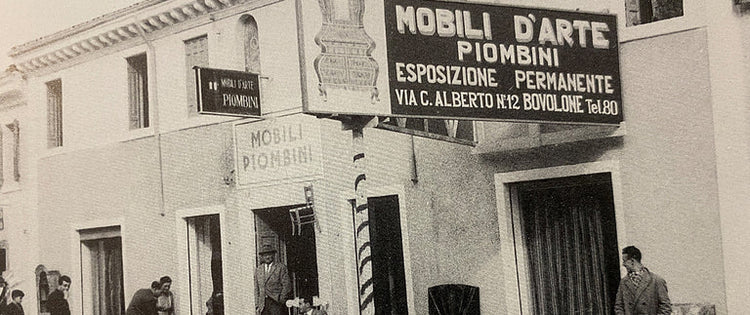
He moved his company first to the district of Pozza, then in Via Carlo Alberto — where Piombini once had a showroom that for years was a point of reference for artisanal elegance, and which for a very long time was also the family residence. There he understood the value that could arise from the union between artisanal tradition and commercial vision.

The intuition: the "exhibition" and the first catalog

In the late 1940s, Mario made two pioneering moves: he built the first "exhibition" of art furniture on Via Madonna, and printed a real catalog to be distributed through representatives and retailers.
That catalog, now a valuable document, contained as many as 108 models, some products made in-house, others selected from the best workshops in Bovolone and Cerea. Baroque styles, Venetian rococo, neoclassical, Maggiolini, but also Renaissance and English, with refined inlays, fine veneers, and a skillful use of noble materials.

A knowledge passed down, a shared passion, an identity that even then looked abroad: the catalog was in three languages, and the first exports to Switzerland and Germany began between 1947 and 1950.

The moral legacy of Roberto Piombini

The book published to celebrate 75 years of activity was not the story of a man, but the story of a land.
Roberto Piombini, with the heart and intelligence of someone who has known how to preserve and innovate, did not want to put himself at the center. He chose to giving voice to the territory, to the family, to work, celebrating values that go beyond time.

This spirit of humility and greatness is one of the most special and distinctive qualities of the man Roberto Piombini — and it still guides us today, in every piece of furniture born from our hands.

The Heart of the Tradition of Veronese Artisans

For 100 years, everything has come from the skilled hands of Veronese artisans, who with passion and precision bring timeless furniture to life. Each piece tells a story made of worked wood, hand-painted, and carefully protected, ready to arrive in the heart of your home. We select only what best represents our tradition, the craftsmanship that has distinguished us for generations and makes us unique. Here is a selection of some products to celebrate with Piombini customers.

Modern Shaped Walnut Wood Container Dresser with LED Modigliani

€3.850,00
€6.423,00

Classic Cherry Double Bed with Padded Capitonné Leather Headboard

€3.400,00
€6.755,00

Contemporary Double Bed in Walnut Wood and Leather

€3.800,00
€7.900,00

Classic Double Bed in Cherry with Carved Headboard – Arte Collection

€2.500,00
€5.100,00

“Ever wondered how we create our coffee? We’d like to reveal a few secrets. From coffee’s discovery
to the ways we harvest our beans today and make the perfect selection for slow roasting,
the history of coffee might surprise you. “

“Ever wondered how we create our coffee? We’d like to reveal a few secrets. From coffee’s discovery
to the ways we harvest our beans today and make the perfect selection for slow roasting,
the history of coffee might surprise you. “

100 YEARS OF HISTORY AND GREAT SATISFACTION